AlgoSpecial_LevelHunterPro — The Complete Technical Guide to Key Levels & VWAP on MT5
Trial: valid until 05 January 2027 · Full version: $80 — algospecial.com or t.me/bullionstrategy
Keywords: MT5 key levels indicator, previous day high low indicator, PDH PDL indicator MT5, daily VWAP indicator, swing high low indicator, round number indicator, liquidity levels indicator, ICT key levels, MT5 levels dashboard.
Levels are where the market keeps its promises
Trading without key levels is like navigating without a map. Price does not move in a vacuum; it reacts at places where many participants have already made decisions — yesterday's high, last week's low, the volume-weighted average price, a round number, a confirmed swing. These are not superstition. They are algorithmic reference points: they are where stop orders cluster, where institutional benchmark orders sit, and where mean-reversion and breakout systems alike trigger. When several of them coincide, the market tends to do something decisive.
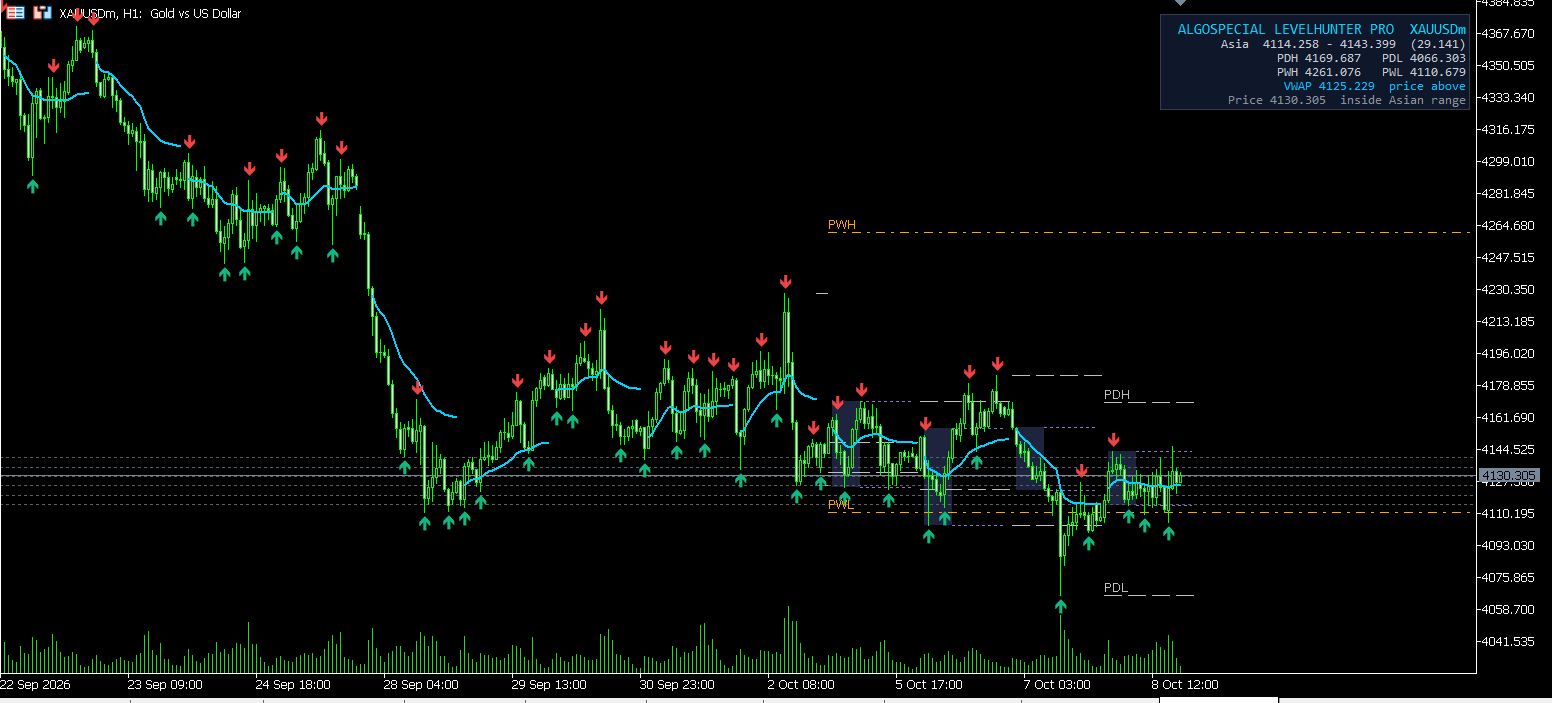
AlgoSpecial_LevelHunterPro collects the levels intraday traders watch most and draws them on one clean MT5 chart, with hover tooltips explaining each. It maps the Asian range (plus optional London and New York boxes), the previous day high/low (PDH/PDL) and previous week high/low (PWH/PWL), a tick-volume-weighted daily VWAP, confirmed swing highs/lows, and round numbers around price — and summarises everything in a toggleable info panel with optional breakout alerts.
This guide explains why each level matters, the exact mechanics of the engine, every input, how to read the chart, and how to turn a wall of lines into a focused trading plan.
1. The logic behind each level
Previous day high/low (PDH/PDL). The prior session's extremes are the market's most recent memory of where buyers and sellers gave way. Breakout traders place stops above PDH and below PDL; mean-reversion traders fade the first test. Either way, PDH/PDL are where liquidity concentrates, which is why they are swept so often.
Previous week high/low (PWH/PWL). The weekly extremes are a higher-order version of the same idea — bigger pools, bigger reactions. They are swing context, and they are the levels that define "is the week still inside its range or breaking out?"
Daily VWAP. The volume-weighted average price is the single price at which the day's traded volume is balanced. Institutions use it as a benchmark for execution quality: above VWAP, buyers are in control of the day's auction; below it, sellers are. A tick-volume-weighted VWAP (which is what LevelHunterPro computes, since forex has no centralised volume) is the closest honest proxy to the institutional VWAP. Its daily reset makes it a fresh, unbiased reference each session.
Swing highs/lows (fractals). A confirmed swing high is a local peak with lower highs on both sides (of a configurable strength). These are the market's structural pivots — the points that define trend, the points that price returns to, and the anchors that many algorithms use to measure momentum. LevelHunterPro draws them only once confirmed, so they do not repaint.
Round numbers. Humans, and the algorithms that model human behaviour, cluster orders at "big figure" prices — 1.1000, 2000.00, 25000. The psychological pull of round numbers is real, especially on indices and gold, and they frequently act as intraday support/resistance.
The Asian range. The overnight accumulation band, discussed at length in the SessionBoxer guide, is the reference the London open most often interacts with.
2. Inside the engine: how LevelHunterPro works
The indicator is pure MQL5 — no DLLs, no WebRequest — and runs fully offline. It computes everything from price history and tick volume:
- Session ranges are built from M1-level history within each session window, then optionally extended forward to a chosen hour so the levels stay live through the day.
- PDH/PDL and PWH/PWL are derived from the previous completed day and week.
- VWAP is accumulated per day as `sum(typical price × tick volume) / sum(tick volume)`, resetting at the day boundary; the first bar of each day is intentionally left empty so days are not joined.
- Swings are confirmed using a symmetric lookback (`SwingLen` bars on each side), and only after the confirmation bars have closed.
- Round numbers are generated around the current price at an automatic step (or a step you set), `RoundCount` levels above and below.
- An automatic light/dark theme detector chooses readable colours for each level, and every object carries a hover tooltip describing what it is.
The engine re-evaluates on a short timer and on chart changes, cleaning up its objects on removal. Completed levels (PDH/PDL, swings) do not move; the live VWAP and session extension lines update in real time.
3. Every input parameter, explained
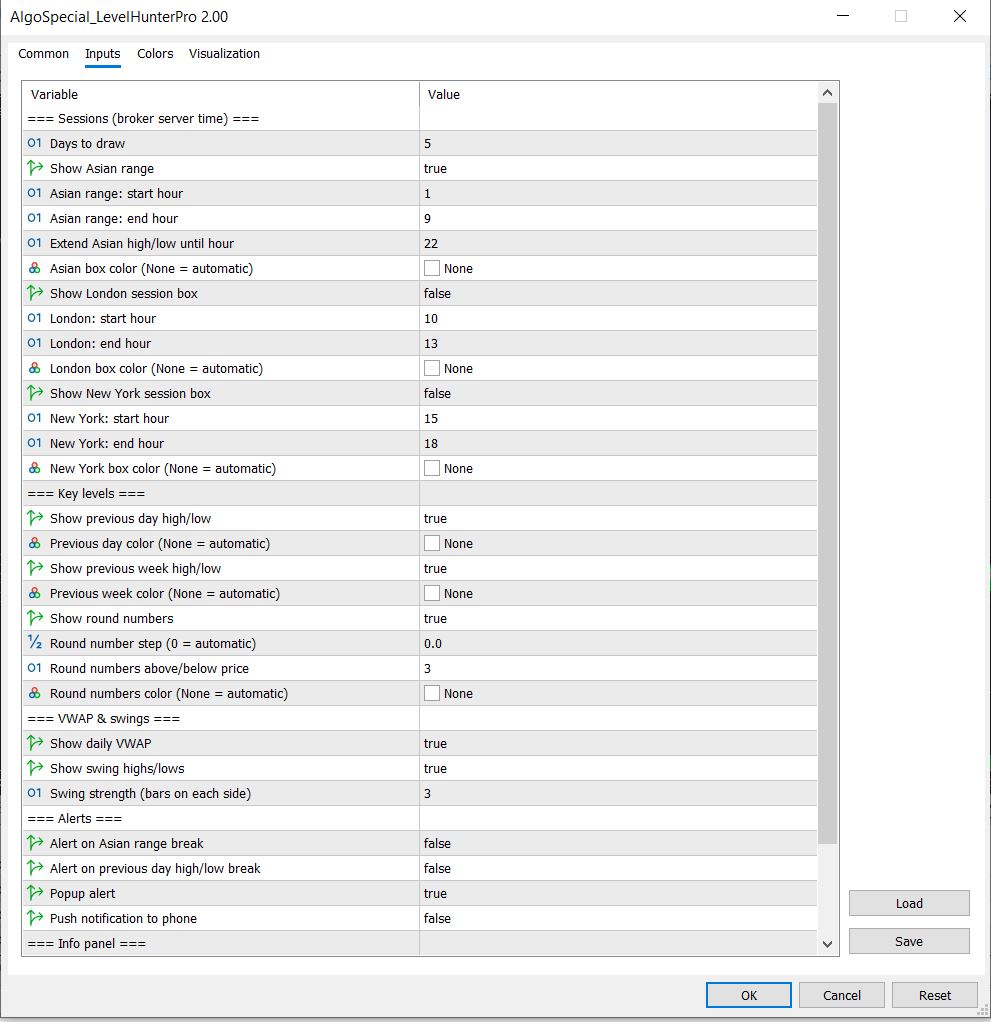
Sessions (broker server time)
- Days to draw — default 5.
- Show Asian range — default true; start/end hour default 1–9; extend to hour default 22.
- Show London / New York boxes — default false; start/end hours configurable.
- Session colors — default `clrNONE` (automatic theme-aware colour); set an explicit colour to override.
Key levels
- Show previous day high/low — default true.
- Show previous week high/low — default true.
- Show round numbers — default true; step default 0 (automatic); count default 3 above/below.
- Level colors — default automatic.
VWAP & swings
- Show daily VWAP — default true.
- Show swing highs/lows — default true; swing strength default 3 bars each side.
Alerts
- Alert on Asian range break — default false.
- Alert on previous day high/low break — default false.
- Popup / push notification — channel toggles.
Info panel
- Show info panel — default true (top-right summary).
Extras
- Print License Information in the Experts Log on Start — default true.
4. Reading the chart
In the screenshot above the chart carries the Asian range box with extension lines, the previous day high/low as dashed levels, the previous week high/low as dash-dot levels, the VWAP as a line, and swing labels. A practical reading method:
- Orient with the higher timeframes first. Where is price relative to PDH/PDL and PWH/PWL? Inside the prior range means balance; outside means expansion.
- Read the VWAP as a compass. Above VWAP, favour longs; below, favour shorts. A clean reclaim or loss of VWAP is a common intraday regime shift.
- Cluster the levels. When PDH coincides with a round number and a swing high, you have a high-probability reaction zone. Isolated levels are weaker.
- Respect the sweeps. A wick through PDH that closes back inside is a liquidity grab, not a breakout — the most tradeable level event there is.
5. Building a plan around levels
- Mean reversion. Fade the first test of a strong level (PDH/PDL, round number, prior-week extreme) when the higher-timeframe trend is ranging — target VWAP or the range midpoint.
- Breakout continuation. When price closes decisively through a level and retests it, trade in the breakout direction, targeting the next level up the ladder.
- Confluence entries. Combine a level with an entry trigger: a fair value gap (ImbalanceZoneX) or divergence (DivergenceRadar) at a level is a far stronger setup than either alone.
- Bias from the matrix. Use TrendMatrixPro to decide which direction of level test to favour.
6. Instruments and timeframes
LevelHunterPro suits anything with intraday structure: forex majors and crosses, gold (XAUUSD), indices (US100, US30, GER40) and crypto. It is drawn from session and daily/weekly data, so it works on any chart timeframe, but M5–M30 is the natural intraday view and H1–H4 for swing context.
7. Risk and prop-firm notes
Level-based trading is inherently rule-friendly, which suits prop firms: defined levels make for defined invalidation. Place stops beyond the level (plus a buffer), require a minimum reward-to-risk, and avoid opening new trades into major level breaks right before high-impact news.
8. Installation
- Copy `AlgoSpecial_LevelHunterPro.ex5` into `MQL5\Indicators\`.
- Refresh the Navigator and attach to a chart.
- Load `AlgoSpecial_LevelHunterPro.set` from the Inputs tab.
- Set session hours to your broker's server time.
9. Download
The compiled EX5 and ready SET are free, with a trial valid until 05 January 2027. Full version $80 — algospecial.com or t.me/bullionstrategy.
10. Advanced: reading VWAP like an institution
The daily VWAP is the day's volume-weighted centre. Institutions measure their own execution against it: buying below VWAP is "good" execution, selling above it is "good" execution. That creates a behavioural bias — desks defend VWAP, and price frequently mean-reverts toward it after stretching away. Three practical reads:
- VWAP as a regime line. Sustained price above VWAP signals a buyer-controlled day; sustained price below signals a seller-controlled day. A clean reclaim or loss of VWAP is one of the most reliable intraday regime shifts.
- VWAP as a magnet. When price is far from VWAP in a range-bound day, the pull back toward it is a high-probability move — often the easiest trade of the session.
- VWAP as a trend confirm. In a trending day, VWAP acts as dynamic support (uptrend) or resistance (downtrend); pullbacks to VWAP that hold are continuation entries.
Because LevelHunterPro's VWAP is tick-volume weighted and resets daily, it is the closest retail-honest analogue to the institutional benchmark. Anchor your intraday bias to it and the level stack becomes a coherent story rather than a pile of lines.
11. Scoring level confluence
Single levels are weak; clusters are strong. Build a quick mental (or written) score: how many independent levels sit within a small price band? A zone where PDH, a round number, a swing high and the previous week high all coincide deserves far more respect than any one of them alone. When price approaches a high-confluence zone, expect either a strong rejection (fade) or a violent break-and-go (breakout) — and let the reaction candle, not the level itself, decide which.
A practical rule of thumb: require two or more independent level types to overlap before you treat a zone as tradeable, and require a structural trigger (a sweep, a fair value gap, or a divergence) before you commit.
12. Liquidity pools and stop hunts
Every visible level is also a pool of resting orders. Stops sit just beyond PDH/PDL, beyond swing highs/lows, and beyond round numbers. That is why the market so often spikes through a level before reversing — the move exists to trigger those stops, after which the real direction emerges. LevelHunterPro makes the pools visible, which turns the classic "stop hunt" from a frustration into a setup: a wick through a level that closes back inside is a liquidity grab, and the subsequent move is frequently in the opposite direction. Combine that with an entry gap (ImbalanceZoneX) for a precise, low-risk entry.
13. The algorithmic case for round numbers
Round numbers are not merely psychological. Many execution and risk algorithms, and a large share of human discretionary orders, are placed at "big figure" prices because they are easy to remember and easy to set as profit targets or stop distances. This concentrates orders at 1.1000, 2000.00, 25000 and similar. The effect is strongest on indices and gold, where the tick values make round numbers natural. Treat round numbers as soft levels: they matter more when they coincide with a harder level (a swing, PDH/PDL, or VWAP), and less in isolation.
14. Parameter tuning matrix
| Instrument | Days | Asian start/end | Show PDH/PDL | Show PWH/PWL | Round step |
|---|---|---|---|---|---|
| EURUSD | 5 | 1–9 | Yes | Yes | Auto |
| GBPUSD | 5 | 1–9 | Yes | Yes | Auto |
| USDJPY | 5 | 1–9 | Yes | Yes | Auto |
| XAUUSD | 5 | 1–8 | Yes | Yes | 10.0 |
| US100 | 5 | 1–7 | Yes | Yes | 50.0 |
| US30 | 5 | 1–7 | Yes | Yes | 100.0 |
Set the round-number step explicitly on high-priced instruments where the automatic step can be too fine or too coarse. Keep the swing strength at 2–3 for intraday and 3–5 for swing charts.
15. Common mistakes
- Treating every level as equal. Weight levels by confluence and by the timeframe that created them.
- Buying at a level without a trigger. The level is the "where"; you still need a "when" — a reaction candle, a sweep, or a gap.
- Ignoring the higher-timeframe context. A daily support level means little if the weekly trend is powering through it. Use TrendMatrixPro.
- Chasing VWAP extensions. Buying far above VWAP in a range day is buying the top of the rubber band.
- Leaving the chart cluttered. Toggle off the levels you do not use for the current session.
16. Backtesting and forward-testing notes
Levels are ideal for visual backtesting because they are fixed. Scroll back and mark how price behaved on the first test of PDH/PDL, PWH/PWL and round numbers: did it reject, break, or sweep-and-reverse? Classify and count. Within a few dozen tests you will know which levels your instrument respects and which it ignores — and you can then prioritise those in real time. Because confirmed swings and completed session levels do not repaint, your review matches reality.
17. The AlgoSpecial level stack in practice
A complete intraday routine: read bias from TrendMatrixPro; map levels with LevelHunterPro; wait for the session window with SessionBoxer; enter on an ImbalanceZoneX gap at a high-confluence level; confirm momentum with DivergenceRadar. Five free, non-repainting, offline tools that together approximate an institutional desk's workflow.
18. Quick-reference cheat sheet
- Orient with the higher timeframes first, then read the intraday levels.
- Above VWAP favours longs; below VWAP favours shorts. A clean reclaim or loss of VWAP is a regime shift.
- Require two or more independent level types to overlap before treating a zone as tradeable.
- A wick through a level that closes back inside is a liquidity grab — often a reversal setup.
- Round numbers are soft levels; they matter most when they coincide with a harder level.
- Trade levels in the direction of the TrendMatrixPro bias.
- Always pair a level with a trigger — a reaction candle, a sweep, or a fair value gap.
- Do not chase VWAP extensions in a range day; wait for the pullback.
- Toggle off the level groups you are not using this session to keep the chart clean.
- Set the round-number step explicitly on gold and indices.
- Confirmed swings and completed session levels do not repaint — review and trust them.
- The level is the where; the entry trigger is the when; the stop beyond the level is the risk.
FAQ
Is AlgoSpecial_LevelHunterPro free? Yes — free `.ex5` + `.set` with a trial until 05 January 2027.
What levels does it plot? Asian range, London/NY boxes, PDH/PDL, PWH/PWL, daily VWAP, swings and round numbers.
Is the VWAP tick-volume weighted? Yes, and it resets at the start of each day.
Does it repaint? No — session levels and confirmed swings are fixed.
Does it alert? Yes — optional alerts on Asian range and previous-day high/low breaks.
Can I turn off the panel? Yes, the info panel is optional.
Does it work on indices and gold? Yes — any MT5 symbol.
Does it need internet or DLLs? No — pure MQL5, fully offline.
Risk disclaimer: educational trading software, not investment advice. Test on demo first. See algospecial.com for the full disclaimer.
Free Download
The compiled MT5 indicator and the ready preset are free to download. Trial valid until 05 January 2027. The MQL5 source is not included; the full version is $80.