AlgoSpecial_SessionBoxer — The Complete Technical Guide to Session Range Boxes on MT5
Trial: valid until 05 January 2027 · Full version: $80 — algospecial.com or t.me/bullionstrategy
Keywords: forex session indicator MT5, Asian session box indicator, London session range indicator, New York session box, session range boxes MT5, average daily range indicator, session breakout alerts, forex market sessions indicator, ICT killzone sessions.
Time is the market's hidden dimension
Price is the axis everyone watches; time is the axis almost everyone ignores. Yet the single most repeatable pattern in intraday trading is not a candle shape or an oscillator reading — it is a time-of-day behaviour. The Asian session accumulates. The London open expands. New York either continues London or reverses it. Every liquid instrument breathes on this rhythm, and the ranges formed in one session become the liquidity pools that the next session hunts.
AlgoSpecial_SessionBoxer makes that rhythm visible on MetaTrader 5. It draws colour-coded high/low boxes for the Asian, London and New York sessions across a configurable number of past days, adds an average session-range statistics panel, and fires optional breakout alerts when price takes a session high or low. It is the time-based counterpart to a price-based levels tool, and together they form the backbone of a session-trading framework.
This guide explains the theory of session liquidity, the exact mechanics inside the engine, every input, how to read the boxes, and how to build both breakout and reversal playbooks around them.
1. Why session ranges are liquidity magnets
Institutional order flow is not distributed evenly across the clock. A large share of daily volume concentrates around session opens, when desks are active, economic data releases, and cash-market opens. Overnight, in the thin Asian hours for Western instruments, price often drifts within a narrow band — the Asian range. That range is not random: it is a coil of resting orders, with stops and pending orders accumulating just beyond its high and low.
When London opens, volatility expands and price frequently sweeps one side of the Asian range before choosing a direction. When New York opens, the same logic repeats against the London range and the day's developing high/low. This is the foundation of ICT "killzone" theory and of classic Asian-range breakout systems alike: the range is where liquidity is stored, and the next session is where it is harvested.
Two facts follow, and both are encoded in SessionBoxer:
- The session high and low are not just lines — they are pools. Trading toward them (as targets) and reacting at their sweep (as entries) are the two core behaviours.
- The size of a session's range is a volatility fingerprint. If today's Asian range is much wider than its average, the market is unusually active; if it is much narrower, the day may be a coiled spring. Knowing the average turns "it feels quiet" into a measurable input.
2. Inside the engine: how SessionBoxer works
SessionBoxer is pure MQL5 with no DLLs and no WebRequest, so it runs fully offline. Its design is built around broker server time, which is the only clock that matters for session alignment — your broker's midnight is not necessarily midnight where you live.
On initialization the indicator validates your session time strings (HH:MM), then starts a one-second timer that drives the drawing logic. For each of the last `DaysBack` days it:
- Resolves each session's start and end datetimes from the day's D1 open plus your start/end hours.
- Scans M1-level price history within that window to find the true session high and low.
- Draws a filled rectangle spanning the session, with an optional midpoint line and an optional range-size label.
- Accumulates average ranges for the stats panel, expressed in pips, across all sessions over the lookback.
- Monitors breakouts and, if alerts are enabled, fires a popup and/or mobile push the first time price crosses a session high or low — once per session per day, to avoid spamming.
The indicator re-draws on chart changes (zoom/scroll) and on the timer, and it cleans up all of its objects on removal, so it never leaves clutter behind. Because it works from completed session data and live prices, the boxes are stable — they do not repaint their highs and lows after a session has closed.
3. Every input parameter, explained
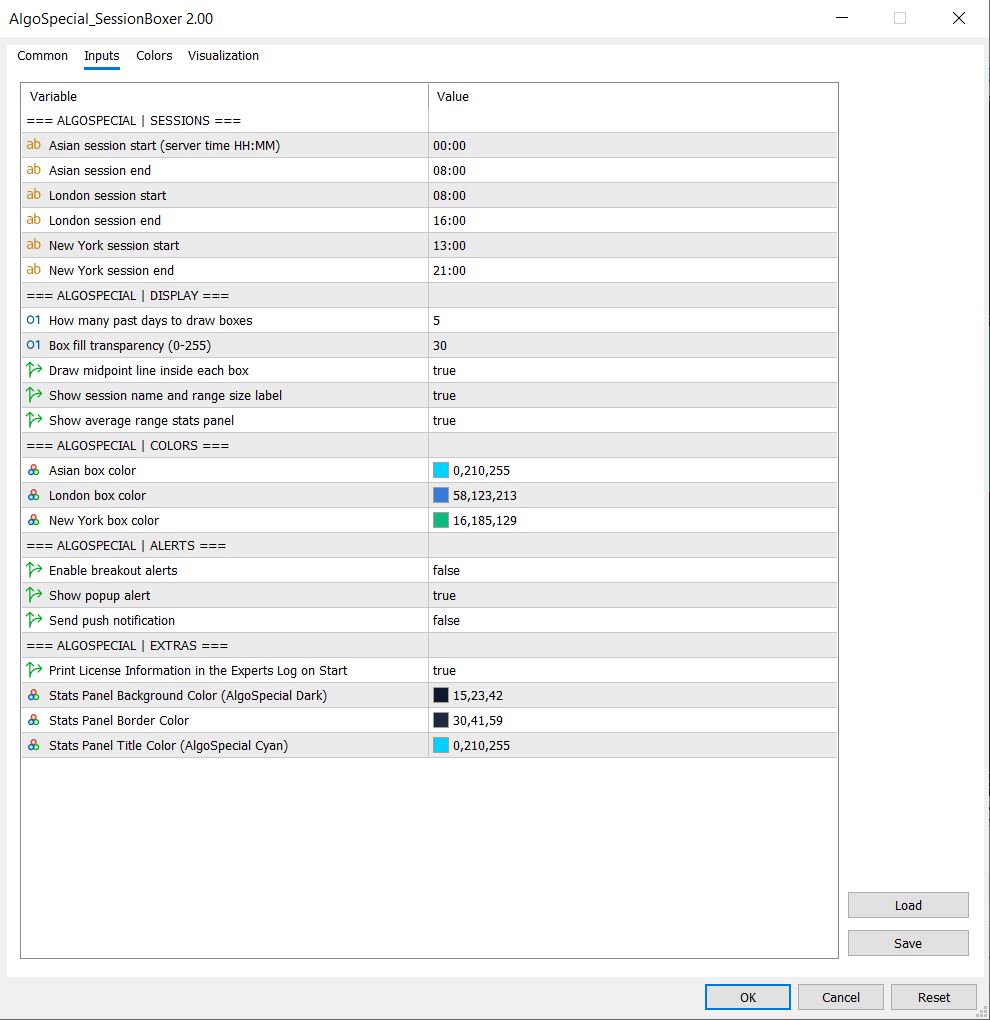
Sessions (broker server time)
- Asian Start / End — default 00:00–08:00. The accumulation window.
- London Start / End — default 08:00–16:00. The expansion window for European instruments.
- New York Start / End — default 13:00–21:00. The US cash-session window.
Adjust these to your broker's server time. Getting them right is the whole game.
Display
- Days Back — default 5. How many past days to draw (1–100).
- Box Fill Transparency — default 30 (0–255). Lower is more opaque.
- Show Midline — default true. Draws the 50% line of each range.
- Show Labels — default true. Session name plus range size.
- Show Stats Panel — default true. The average-range panel.
Colors
- Asian / London / New York colors — default AlgoSpecial cyan `0,210,255`, blue `58,123,213`, green `16,185,129`.
Alerts
- Enable Breakout Alerts — default false. Master switch.
- Show Popup / Send Push — choose notification channels.
Extras
- Panel Background / Border / Title colors — AlgoSpecial dark palette defaults.
- Print License Information in the Experts Log on Start — default true.
4. Reading the boxes
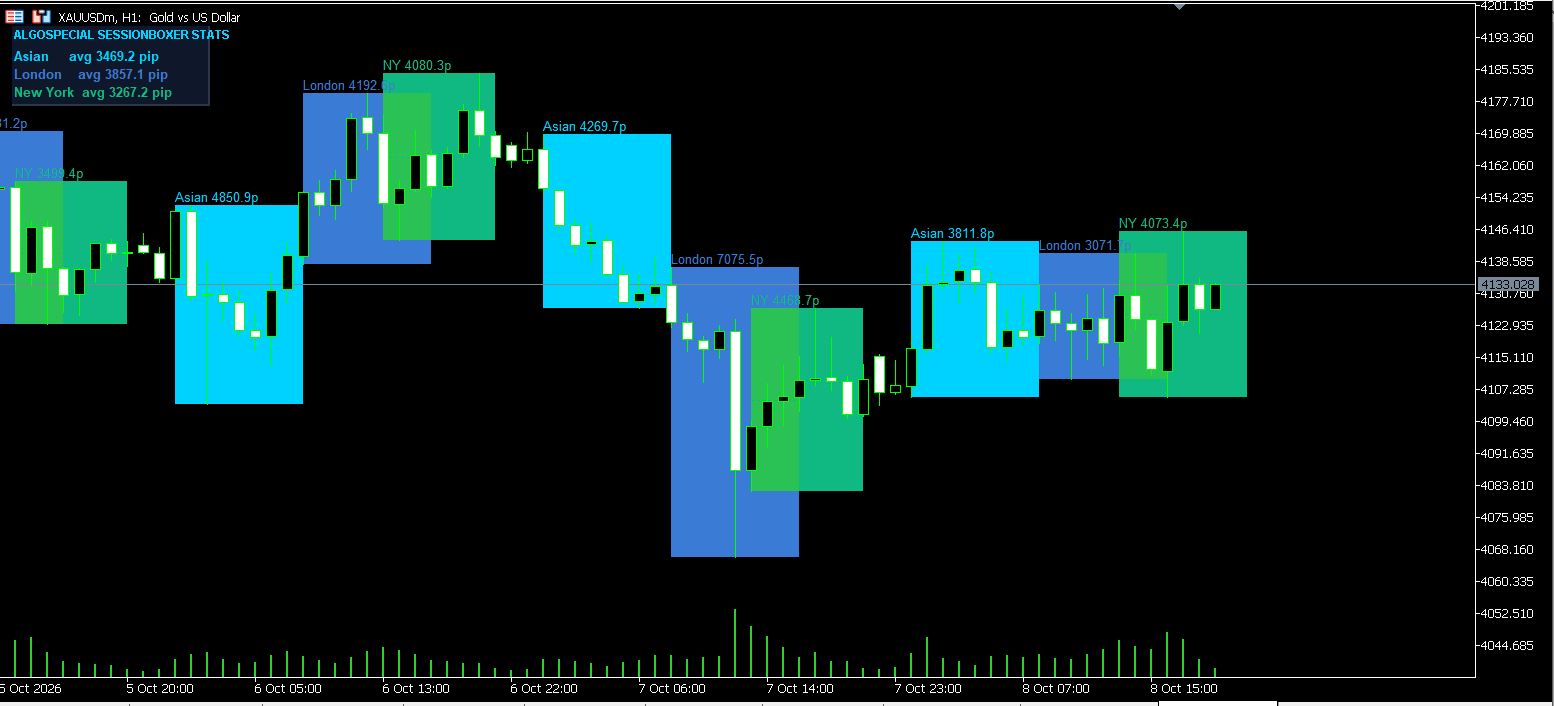
In the chart screenshot above, each session is a distinct coloured box with a midpoint line and a label. Three reading habits matter:
- Compare range sizes. Look at the stats panel: if today's Asian range is below average, expect an expansion day; if it is already above average, the day's move may be partly spent.
- Watch the sweep, not the break. The highest-quality session signal is a failed breakout — price pokes beyond the Asian high or low, then closes back inside. That is a liquidity sweep, and it usually precedes a move in the opposite direction.
- Use prior-session highs/lows as targets. The London range high often becomes the New York target, and vice versa. Session boxes give you pre-defined, market-recognised objectives.
5. Two playbooks
A. Asian-range breakout (trend day). Mark the Asian high and low. At the London open, wait for a decisive close beyond one side, then enter on a retest of the broken edge. Target the day's average range extension. Use TrendMatrixPro to confirm the higher-timeframe bias so you do not fade a strong trend.
B. Asian-range sweep reversal (range day). When price sweeps the Asian high or low during London/NY and closes back inside, look for a reversal entry back toward the opposite side of the range, ideally confirmed by a fair value gap (ImbalanceZoneX) or divergence (DivergenceRadar). Target the range midpoint first, then the opposite edge.
6. Instruments and timeframes
SessionBoxer is ideal for instruments with a clear session character: forex majors and crosses, gold (XAUUSD), and indices (US100, US30, GER40). Crypto trades 24/7, so session boxes there are most useful as time-of-day volatility zones rather than hard opens. Any timeframe works — the boxes are drawn from session time, not chart time — but M5–M30 charts give the clearest intraday view.
7. Risk and prop-firm notes
Session-based trading is naturally prop-firm friendly because it limits activity to specific windows and reduces overnight exposure. Combine session entries with a fixed stop beyond the sweep extreme and a reward-to-risk of at least 1:2, and remember that the "Friday late" guard (avoiding new positions late on Fridays) is a common challenge rule.
8. Installation
- Copy `AlgoSpecial_SessionBoxer.ex5` into `MQL5\Indicators\`.
- Refresh the Navigator and attach to a chart.
- Load `AlgoSpecial_SessionBoxer.set` from the Inputs tab.
- Set your session hours to your broker's server time.
9. Download
The compiled EX5 and ready SET are free, with a trial valid until 05 January 2027. Full version $80 — algospecial.com or t.me/bullionstrategy.
10. Advanced: turning average range into position sizing
The stats panel is not decoration — it is a risk-management input. Once you know the average pip range of a session, you can set targets and stops as fractions of it rather than arbitrary numbers. A common institutional-style approach: measure the average daily range (ADR) and the average Asian range; then set intraday profit targets at roughly 0.5–1.0× the remaining expected range, and place stops so that a normal session's noise does not take you out. On a day where the Asian range is already far above its average, the remaining upside is statistically smaller — a reason to reduce target size or stand aside. On a day where it is unusually compressed, the expansion potential is larger.
This single habit — sizing by measured range rather than fixed pips — is one of the clearest separators between traders who survive and those who blow up on a volatility spike.
11. Killzones and the session overlap
ICT "killzones" are time windows within the sessions where liquidity and volatility peak: the London killzone around the London open, the New York killzone around the US cash open, and the London–New York overlap (roughly 13:00–16:00 server time on many brokers), which is the single most liquid window of the trading day for Western instruments. SessionBoxer does not label killzones explicitly, but the boxes make them obvious: the overlap is where the London and New York boxes intersect, and that intersection is where the highest-probability moves occur.
A practical killzone routine: mark the Asian range overnight; at the London open, watch for the first sweep of the Asian high or low inside the London box; if price reverses and closes back inside, the New York session often delivers the follow-through. Trading only within killzones reduces the number of trades and increases their average quality — the same principle that makes MTF alignment powerful.
12. Day-of-week and event effects
Session behaviour is not uniform across the week. Mondays often open with gap-fill and range behaviour as the market digests the weekend; Tuesdays and Wednesdays are frequently the most trending; Thursdays can carry momentum into data releases; Fridays compress late as participants square positions (and many prop firms forbid holding over the weekend). Layer high-impact economic events on top: NFP on the first Friday, CPI and central-bank meetings, and month-end flows all distort the normal session rhythm. The right response is not to avoid sessions but to widen stops, reduce size, or skip the session when a red-folder event is imminent — a rule SessionBoxer supports indirectly by making the time context explicit.
13. Parameter tuning matrix
| Instrument | Asian window (server) | London window | NY window | Days back |
|---|---|---|---|---|
| EURUSD / GBPUSD | 00:00–08:00 | 08:00–16:00 | 13:00–21:00 | 5 |
| USDJPY / AUDUSD | 00:00–08:00 | 08:00–16:00 | 13:00–21:00 | 5 |
| XAUUSD (gold) | 00:00–07:00 | 08:00–16:00 | 13:00–21:00 | 5 |
| US100 / US30 | 00:00–07:00 | 08:00–16:00 | 14:30–21:00 | 5 |
Adjust to your broker's server offset. The single most common mistake is leaving the defaults on a broker whose server time differs from your assumption — always verify by checking where the boxes land against known session opens.
14. Common mistakes
- Wrong session hours. If your boxes do not line up with the actual opens, every signal is built on sand. Verify the server offset first.
- Trading the breakout without confirmation. A wick beyond the range is not a break; a close beyond it is. Require a decisive close and ideally a retest.
- Ignoring range size. Taking a full-size breakout trade on a day that has already spent its range is how accounts bleed.
- Overlapping too many boxes. Keep `DaysBack` modest so the chart stays readable; 3–5 days is plenty for intraday.
- Forgetting the news. Session structure is a framework, not a shield against a CPI release.
15. Backtesting and forward-testing notes
To validate a session model, replay several weeks and classify each day as breakout, reversal, or range. Then check whether the classification correlated with the Asian range size relative to its average. In most trending instruments you will find that compressed Asian ranges precede expansion days and oversized ranges precede contraction — a measurable edge you can formalise into entry criteria. Because the boxes are drawn from completed session data, your historical review matches what you would have seen live.
16. Pairing SessionBoxer with the AlgoSpecial stack
SessionBoxer provides the when; the other AlgoSpecial tools provide the where and the what. A complete routine: use TrendMatrixPro for directional bias, SessionBoxer for the session window and range, LevelHunterPro for the key levels inside that window, ImbalanceZoneX for the entry gap, and DivergenceRadar for momentum confirmation. That five-tool stack is a full institutional-style workflow built from free, non-repainting, offline indicators.
17. Quick-reference cheat sheet
- Set session hours to broker server time first — every signal depends on this being correct.
- Asian range = accumulation; London = expansion; New York = continuation or reversal.
- A sweep that closes back inside the range is a higher-quality signal than a raw breakout.
- Size targets and stops as fractions of the measured average range, not fixed pips.
- The London–New York overlap is the most liquid window of the day — trade it selectively.
- Compressed Asian range → expect expansion; oversized range → expect contraction.
- Avoid new positions late on Fridays; many prop firms forbid weekend holding.
- Keep DaysBack at 3–5 so the chart stays readable intraday.
- Breakout alerts fire once per session per day to avoid spam.
- Re-verify the boxes against known session opens after any broker or server change.
- Pair the boxes with a level tool and an entry trigger — the session is the when, not the what.
- If your boxes do not line up with the real opens, stop trading the model until they do — a wrong clock invalidates everything downstream.
FAQ
Is AlgoSpecial_SessionBoxer free? Yes — free `.ex5` + `.set` with a trial until 05 January 2027.
Which sessions does it draw? Asian, London and New York, for a configurable number of past days.
Can I change session times? Yes — set each session's start/end in broker server time (HH:MM).
Does it show average ranges? Yes — the stats panel shows mean pip range per session over the lookback.
Does it send alerts? Yes — optional popup and push alerts on session high/low breaks, once per session per day.
Does it repaint? No — completed session highs/lows are fixed.
What is a session sweep? A failed breakout where price briefly exceeds a session high/low and then closes back inside.
Which markets suit it best? Forex, gold and indices; crypto can use it as a time-of-day volatility map.
Does it need internet or DLLs? No — pure MQL5, fully offline.
Risk disclaimer: educational trading software, not investment advice. Test on demo first. See algospecial.com for the full disclaimer.
Free Download
The compiled MT5 indicator and the ready preset are free to download. Trial valid until 05 January 2027. The MQL5 source is not included; the full version is $80.