XAUUSD RSI EA Strategy 2026: MT5 Rules, News Filter, Backtest Plan
A practical, text-first blueprint for building a gold RSI Expert Advisor in MetaTrader 5. The goal is not to catch every turn. The goal is to wait for real exhaustion, avoid news spikes, control daily risk and make the backtest honest enough to trust.
Why RSI Works Differently on Gold
RSI is simple: it measures recent momentum and compresses it into a 0 to 100 oscillator. The mistake is treating every RSI reading above 70 as a sell and every reading below 30 as a buy. That approach fails badly on XAUUSD because gold can keep trending after it becomes "overbought" or "oversold".
Gold is not a quiet major currency pair. It reacts to real yields, USD strength, central bank expectations, inflation data, risk sentiment and liquidity shocks. During a strong macro move, RSI can stay above 70 for hours. A weak EA sells too early. A better EA waits for deeper exhaustion, filters abnormal news conditions and uses the session context to decide whether the signal is tradable.
For automation, this means RSI should be used as an exhaustion trigger, not as a complete strategy. The trading system still needs spread rules, session timing, news blackout, position sizing, trade limits and a realistic exit model.
The Core Strategy Rules
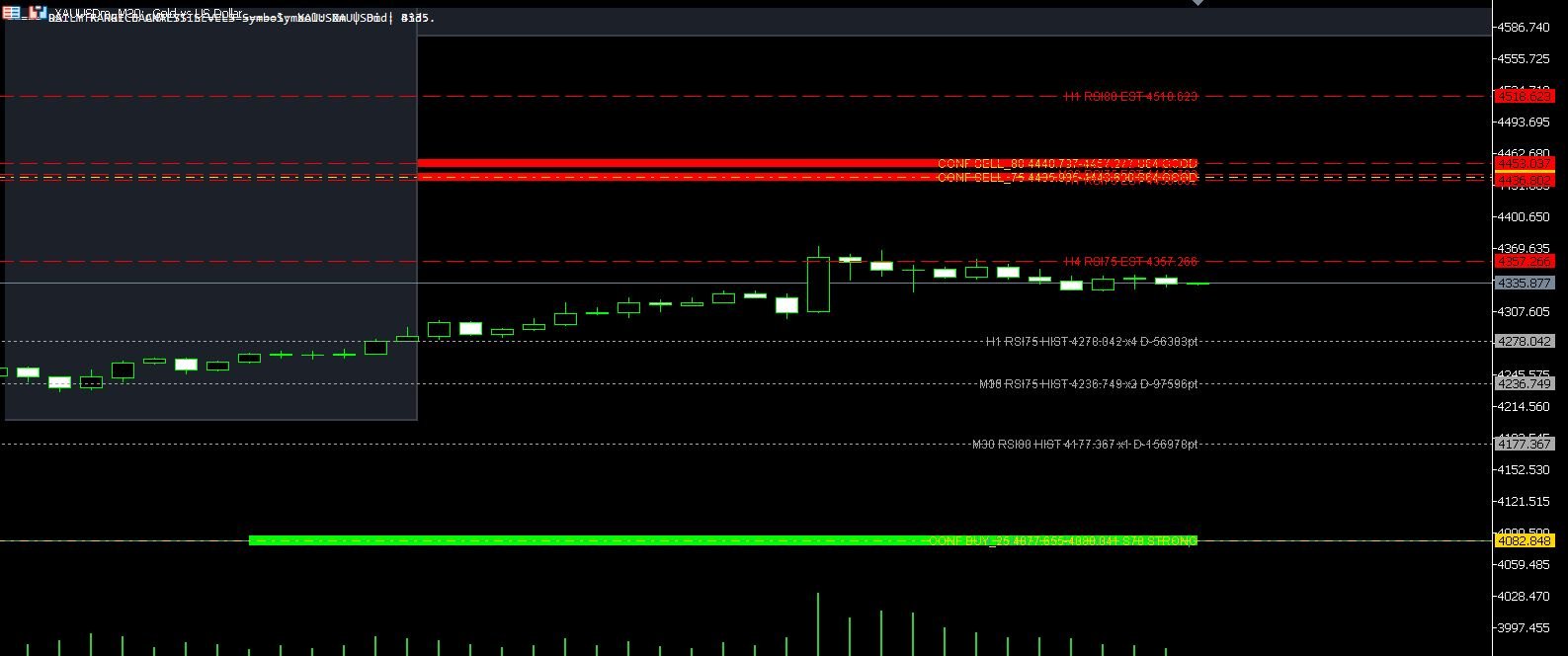
This RSI strategy is designed for XAUUSD on MT5 as a mean-reversion system. It waits for gold to stretch too far, then enters only when the market is not inside a dangerous news or spread condition.
| Rule | Setting | Reason |
|---|---|---|
| Indicator | RSI 14 to 22 | Short enough to react, long enough to avoid noise. |
| Sell trigger | RSI at or above 80 | Avoids weak 70-level signals during trends. |
| Buy trigger | RSI at or below 20 | Forces stronger downside exhaustion before buying. |
| Timeframes | M15, M30, H1, H4 | Catches both intraday and swing exhaustion. |
| News filter | Block 60 to 90 minutes around high-impact USD events | Prevents fading violent macro candles. |
| Spread filter | No trade when spread exceeds limit | Protects entries during rollover and volatility spikes. |
| Daily limit | Stop after daily loss threshold or max trade count | Keeps one bad session from becoming account damage. |
Why 80/20 Beats 70/30 for an Automated Gold EA
The default RSI 70/30 setting is useful for chart reading, but it is often too sensitive for a robot trading gold. A human trader can see when a 70-level signal appears inside a strong breakout and decide to skip it. A robot needs rules that reduce this ambiguity.
The 80/20 threshold creates fewer trades, but the trades are usually cleaner. It forces the EA to wait for genuine overextension. This matters on XAUUSD because price often pushes far beyond the first overbought or oversold reading before mean reversion begins.
If you want more trades, test 75/25 as a middle ground. If you want cleaner prop-firm behavior, start with 80/20 and only loosen the setting if the backtest remains stable across multiple years, spreads and market regimes.
The News Filter Is Not Optional
Most RSI gold EAs fail during the exact moments traders find most exciting: CPI, NFP, FOMC, unemployment claims, Powell speeches and surprise inflation headlines. RSI reaches an extreme, the EA fades it, spreads widen, slippage increases and the market keeps moving.
A practical XAUUSD RSI EA should pause new entries before and after high-impact events. The simplest rule is a 60-minute block before and a 60-minute block after major USD news. A stricter version uses 90 minutes on both sides for CPI, NFP and FOMC.
Existing trades are a separate decision. Some EAs close before news. Others stop opening new positions but allow existing trades to manage normally. For prop-firm accounts, the conservative version is usually better: reduce exposure before major news and restart only after spreads normalize.
Entry Logic: Do Not Buy or Sell the First Touch Blindly
A raw RSI trigger is simple: buy when RSI is below 20 and sell when RSI is above 80. That is not enough. The EA should avoid entering during bad market states.
- Buy setup: RSI reaches 20 or below, spread is acceptable, no major news is active, trade count is below the daily cap and price is not breaking downward in a one-direction news candle.
- Sell setup: RSI reaches 80 or above, spread is acceptable, no major news is active, trade count is below the daily cap and price is not breaking upward on abnormal momentum.
- Better confirmation: wait for RSI to leave the extreme zone or for the next candle to stop making a new high or low.
The confirmation step reduces trade count, but it improves survivability. With RSI systems, the best trade is often not the first touch of the level. It is the failed continuation after the extreme.
Exit Logic: Fixed Profit, Basket Close or Structure Exit?
There are three realistic exit models for a gold RSI EA. Each has trade-offs.
- Fixed money target: useful for small accounts and simple backtests. The EA closes when floating profit reaches a set amount.
- RSI mean reversion exit: buy trades close when RSI returns toward the middle zone; sell trades close when RSI falls back from overbought.
- Basket close: useful only when the EA can hold more than one position. The combined floating profit of all related trades is closed at a target.
For a first version, use one clean exit. Do not mix five exits until the strategy becomes impossible to diagnose. If you use basket logic, cap the number of trades and avoid martingale lot growth.
Recovery Logic Without Martingale
Recovery logic is dangerous when it quietly becomes martingale. A martingale EA increases lot size after losses to recover faster. This can look excellent in a short backtest, but one extended gold trend can erase months of profit.
A safer recovery model is capped and smaller. For example, Trade 1 opens at a normal lot size. If it moves against the signal by a defined floating-loss threshold, Trade 2 may open with a smaller lot, not a larger lot. Both trades then close together at a modest basket profit.
This is still risk. It must be tested carefully. The difference is that the risk is defined. There is a maximum number of trades, a maximum daily loss and no infinite averaging.
Prop Firm Risk Rules for a Gold RSI Robot
Prop-firm trading changes the design goal. The EA does not need to maximize profit per day. It needs to avoid violating daily loss, total drawdown and consistency rules. A strategy that makes money but breaches the daily limit is still a failed strategy.
| Control | Recommended Rule |
|---|---|
| Risk per trade | 0.25% to 1% depending on account size and stop model. |
| Daily loss stop | Stop trading before the official daily loss limit is reached. |
| Max daily trades | 3 to 5 new entries per day. |
| News exposure | No new entries around high-impact USD news. |
| Weekend exposure | Close or stop trading before Friday market close. |
A prop-firm-safe RSI EA should act boring most of the time. That is the point. The account survives because the robot knows when not to trade.
Backtest Checklist Before You Trust the EA
Do not judge an RSI EA from one perfect month. Test the uncomfortable parts: trending gold, news weeks, low-volatility Asian sessions, wide spread periods and different broker symbols.
- Run at least 3 years if data is available, not only the latest winning window.
- Use realistic spread and commission assumptions.
- Test with and without the news filter to see how much it changes drawdown.
- Check max floating drawdown, not only closed-trade drawdown.
- Look at the worst day and worst week, because prop firms care about these.
- Forward test on demo before using a live or funded account.
- Repeat tests on your broker's exact XAUUSD symbol and contract settings.
How This Connects to RSI Pair Trader News
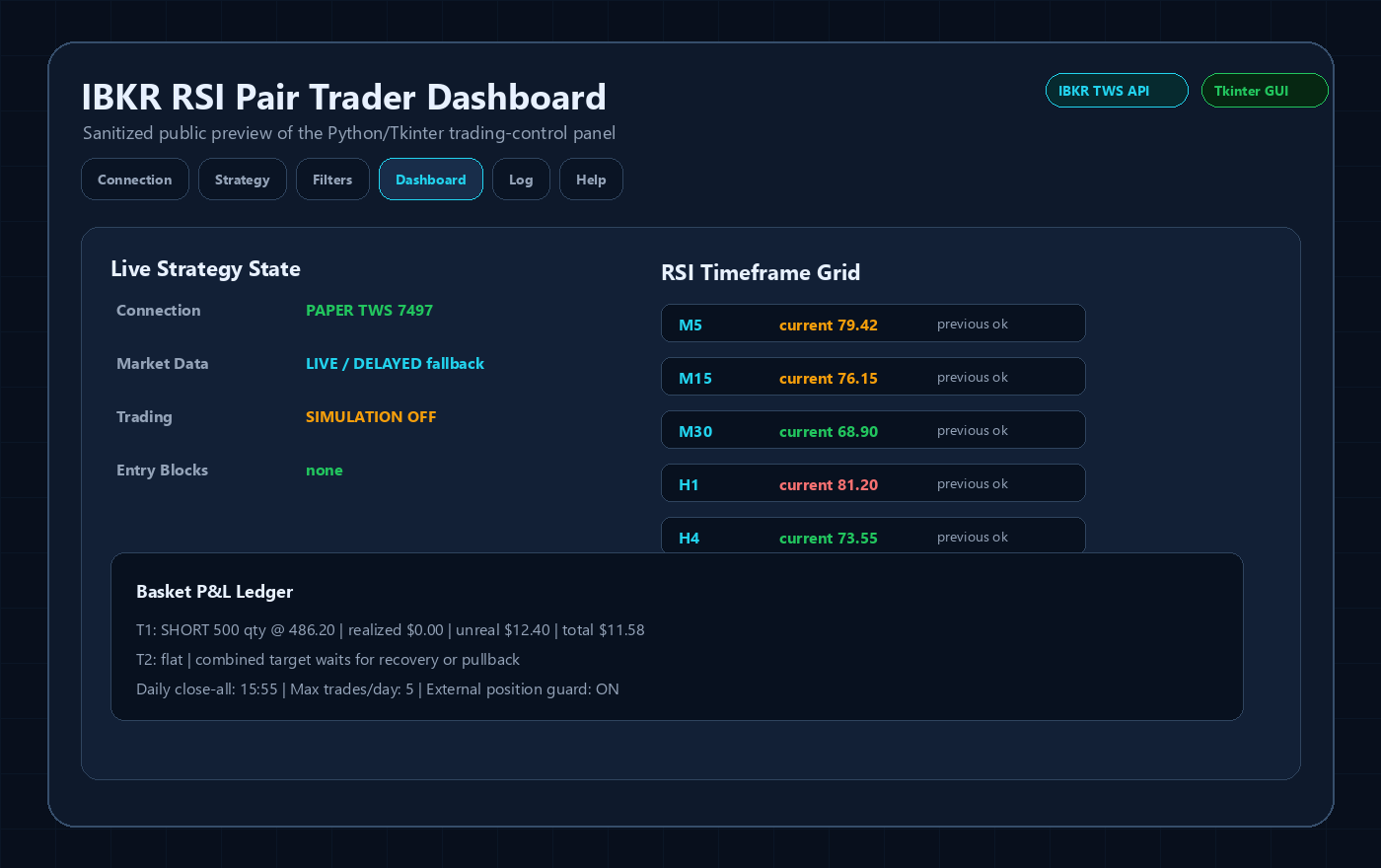
AlgoSpecial already publishes a free MT5 gold robot called RSI Pair Trader News. It follows the same general idea: RSI exhaustion on gold, multi-timeframe monitoring, news protection and controlled recovery behavior.
If you want to study the finished robot instead of building from scratch, start with the free gold EA download page. If you need custom parameters, source code, white-label licensing or a prop-firm-specific version, the same strategy can be rebuilt as a custom MQL5 Expert Advisor.
Frequently Asked Questions
What is the best RSI setting for a XAUUSD EA?
Start with RSI 14 to 22 and 80/20 trigger levels. RSI 14 reacts faster. RSI 22 is smoother. The 80/20 threshold is usually better than 70/30 for automation because it filters weaker gold signals.
Should a gold RSI EA use a news filter?
Yes. XAUUSD is extremely sensitive to USD news and central bank expectations. Blocking entries around CPI, NFP, FOMC and major speeches can reduce avoidable losses from spread spikes and one-direction news candles.
Can an RSI EA pass a prop firm challenge?
Possibly, but only with risk controls. The EA needs daily loss limits, max trade count, conservative lots, no unlimited recovery, news filters and spread filters. The RSI signal is only one part of the system.
Is RSI 70/30 or 80/20 better for XAUUSD?
For manual trading, 70/30 can be useful. For a gold EA, 80/20 is usually safer because it waits for stronger exhaustion and reduces the number of false countertrend trades.
Should an RSI gold EA use martingale?
No. Martingale is dangerous on gold because XAUUSD can extend far beyond normal RSI extremes. If recovery logic exists, it should be capped, smaller than the first trade and protected by daily loss controls.
Need This RSI Strategy Built as an MT5 EA?
Send us your RSI levels, timeframes, lot rules, news-filter rules and prop-firm limits. We can turn the strategy into a clean MQL5 Expert Advisor with source code, testing notes and account-specific risk settings.