Free MT5 RSI Research Indicator
Volatility-Adaptive RSI Thresholds for MT5
An RSI threshold should not behave the same in quiet chop and high-volatility gold expansion.
Compiled file only. Install in MQL5/Indicators. Source code is not included.
What It Solves
Traders who want RSI signals conditioned by realized volatility or normalized ATR regimes.
Use it after the percentile tool: the first asks "is RSI extreme for this market?" while this one asks "is RSI extreme for this volatility regime?"
Technical Method
Current volatility is ranked against prior volatility observations. The indicator then searches older bars with similar volatility percentile states and learns RSI lower and upper quantiles from that matched sample only.
How This Indicator Works In Practice
Volatility-Adaptive RSI Thresholds asks whether today's RSI is extreme for today's volatility. In quiet markets, RSI may reverse before it reaches 30/70. In explosive markets, RSI can stay stretched for a long time. This indicator learns separate RSI tails from historically similar volatility states.
The important idea is conditional sampling. It ranks current volatility, finds past bars with a nearby volatility percentile, then calculates the RSI tails from that comparable set. For XAUUSD, indices, and crypto, this is often more realistic than fixed RSI levels.
Input Parameters Explained
| Input | Default | Meaning | Tuning Guidance |
|---|---|---|---|
InpRSIPeriod |
14 | Wilder RSI period. | Use 10-14 for intraday, 21+ for smoother swing signals. |
InpAppliedPrice |
PRICE_CLOSE | Price series used by RSI. | Close is the clean default. |
InpVolatilityMethod |
VOL_REALIZED_LOG_RETURN | Chooses realized log-return volatility or normalized ATR. | Log-return is cleaner for research. Normalized ATR is easier for discretionary traders to relate to chart range. |
InpVolatilityPeriod |
20 | Bars used to calculate volatility. | 10-14 reacts faster. 20 is balanced. 50 is smoother. |
InpVolRankLookback |
252 | Prior volatility observations used to rank current volatility. | Shorten for intraday adaptation, lengthen for stable regime ranking. |
InpConditionLookback |
1000 | Historical bars searched for similar volatility states. | Use 500 for fast markets, 1000-2000 for stronger sample quality. |
InpVolBandwidthPct |
10.0 | How close a historical volatility percentile must be to current volatility. | 5 is selective, 10 is balanced, 20 gives more samples but less precision. |
InpMinConditionalSamples |
60 | Minimum similar-volatility RSI observations required. | Lower for scalping responsiveness, higher for research confidence. |
InpLowerRSIQuantile |
5.0 | Conditional oversold RSI tail. | 10 for more trades, 5 for balanced signals, 2.5 for selective signals. |
InpUpperRSIQuantile |
95.0 | Conditional overbought RSI tail. | 90 for more trades, 95 default, 97.5 selective. |
InpSignalMode |
VARSI_SIGNAL_EVERY_EXTREME_BAR | Marks every extreme bar or only first entry. | Entry-only is better for alerts and automation ideas. |
InpMaxBars |
5000 | Maximum calculated/displayed bars. | Reduce for VPS speed. |
InpEnableAlerts |
false | Enables alerts. | Enable after visual validation. |
InpAlertOnClosedBar |
true | Uses closed bar or live bar for alerts. | Closed-bar is safer for most traders. |
Parameter Ideas By Trader Type
XAUUSD Day Trader
Gold traders who need RSI thresholds to widen during volatile sessions.
Suggested direction: RSI 14, vol period 20, condition lookback 1000, bandwidth 10-15, tails 5/95.
Crypto / Index Trader
Markets with volatility clustering and frequent regime shifts.
Suggested direction: RSI 14, ATR volatility mode, vol period 20-30, bandwidth 15-20.
Conservative Filter
Lower frequency use where signal quality matters more than count.
Suggested direction: RSI 21, lookback 1500-2000, min samples 80-120, tails 2.5/97.5.
These are research starting points, not guaranteed profitable presets. Test each symbol and timeframe with realistic spread, commission, slippage, and session filters before using any RSI signal in live trading.
Where It Fits In The RSI Stack
This indicator is part of the AlgoSpecial RSI Research Cluster: six MT5 indicators designed to answer the questions a fixed RSI line cannot answer alone. The cluster covers percentile tails, volatility-conditioned thresholds, two-dimensional expectancy, oversold continuation risk, stressed-market rebound probability, and Hidden-Markov regime probabilities.
FAQ
Is this a buy and sell signal indicator?
It can plot arrows, but it is best treated as a research-grade RSI decision layer. Confirm entries with market structure, spread, session, volatility, and risk rules.
Does the free download include source code?
No. The free download is the compiled MT5 .ex5 file only. This keeps the proprietary research logic protected while still letting traders test the indicator.
Can I use it on XAUUSD, forex, crypto, or indices?
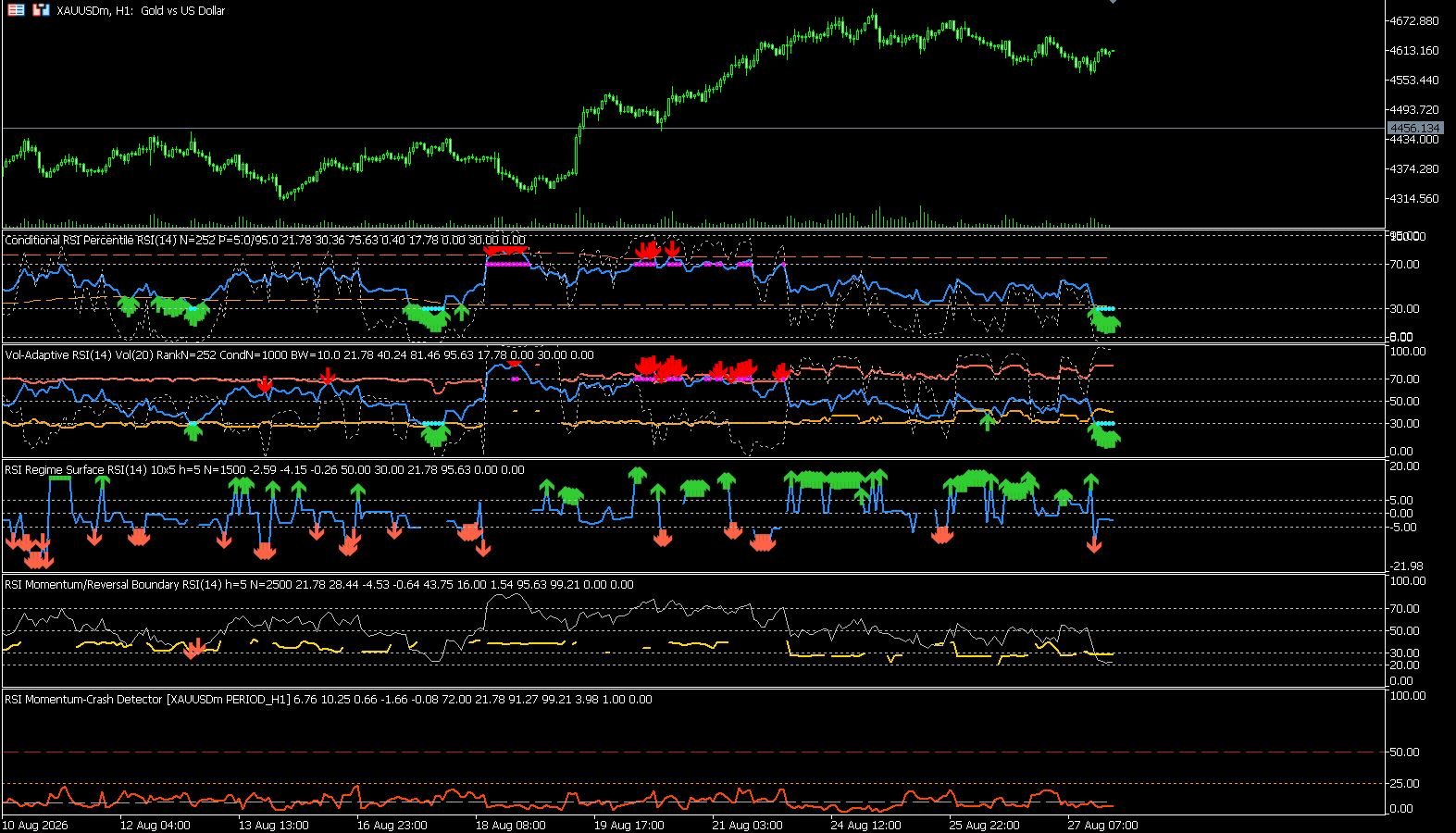
Yes, it is symbol based and can be attached to MT5 charts. The included chart image uses XAUUSD H1 because gold exposes RSI regime changes very clearly, but the logic is not limited to gold.